
6 Longevity Interventions That Really Passed the Test
Hey, Methuselah, what drug are you taking to live that long?
Dr. Jorge Romero
Published: Jun 24, 2026
If you spend enough time on the internet, you’ll quickly discover that living to 120 is no longer ambitious for the average internet user. Just a couple of supplements, and you’re done. We scientists usually refer to these as longevity interventions. Apparently, we should all be aiming for 150, 200, or even the legendary 969 years supposedly reached by Methuselah.
Every day there’s a new miracle promising to slow aging, reverse aging, or stop aging altogether. A supplement you’ve never heard of. A molecule discovered last week. A secret compound that “Big Pharma doesn’t want you to know about.” Some even come with 24-hour delivery. And for less than 20 bucks. And yet, despite all these miracles, most of us are still expected to live less than one-tenth as long as Methuselah, which is not that bad.
So, what’s going on? Are any of these interventions actually working?
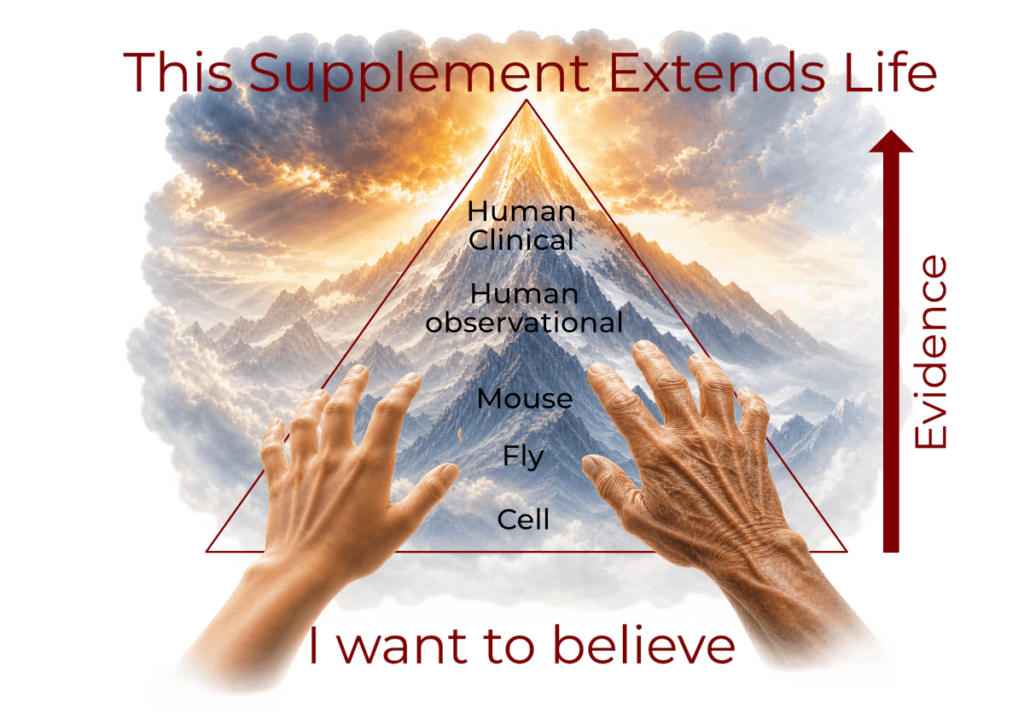
The answer is yes—and no. And the difference lies in the quality of the evidence.
Read time: 14 min
Why Most Longevity Claims Fail
Aging is extraordinarily complex. It’s not a single disease, a single pathway, or a single process. It’s the gradual accumulation of changes occurring across virtually every cell, tissue, and organ in the body. That complexity is exactly why separating scientific evidence from wishful thinking can be so difficult.
One thing I learned during my years in translational aging research at the U.S. National Institute on Aging (NIA) is that biology has a habit of humbling us. A drug can look incredibly promising in the laboratory, extend lifespan in mice, and generate enormous excitement—only to show little or no benefit when tested in humans. The journey from scientific discovery to an effective treatment is often much longer and more complicated than we’d like to believe.
Of course, none of this means that laboratory research is easy. Any graduate student reading this is probably rolling their eyes right now. Researchers like to talk about “controlled conditions,” but they rarely mention the rat that refuses to eat the carefully designed experimental diet after months of planning. Nor do they mention the mouse assigned to the exercise group that decides physical activity is overrated, partially dismantles the running wheel, drags over its Nestlet, and transforms the exercise apparatus into a cozy bedroom. Instead of running all night, it sleeps comfortably until morning. I often wonder where that little high-tech engineer ended up. MIT? Harvard? Yale? (This is a true story).
Animals are often the least of your problems. During my predoctoral years, I spent months trying to persuade compounds like urolithins and ellagic acid to behave like drugs instead of stubborn chemistry experiments—endless rounds of optimizing formulations, testing encapsulation systems, and coaxing molecules across biological membranes just to get them inside cells.
A molecule can show remarkable biological effects in human cells growing in a laboratory dish, yet the real challenge often begins when you try to deliver it to the right place in a living organism, which is why researchers have developed lipid micelles, nanoparticles, liposomes, and encapsulation systems: to protect promising compounds from premature breakdown and give them a fighting chance of reaching their targets intact.
The real challenge begins
when you try to deliver a molecule
to a living organism…
Between cell cultures and mice, researchers also rely on simpler organisms: C. elegans, a tiny roundworm that lives only a few weeks, and the fruit fly Drosophila, which typically makes it to one or two months.
Ok, Wait a minute. A worm? A fly? For human-oriented aging research? You’ve got to be kidding.
No. That brevity is an asset — it allows researchers to observe an entire lifespan within a single experiment. More importantly, worms and flies share a surprising number of genes and biological pathways with us, and their genomes can be manipulated with a precision impossible in mammals. Studies in these tiny organisms revealed the core pathways that regulate aging across species — including insulin/IGF-1 signaling and the nutrient-sensing TOR pathway — discoveries that ultimately contributed to interventions like rapamycin. The next time someone dismisses a study because it was done in an invertebrate, it is worth remembering that some of the most important ideas in aging biology started there.
Human: The Inconvenient, Uncontrolled Variable
Humans add an entirely different level of complexity. Unlike laboratory animals, people come with different diets, lifestyles, medications, cultural practices, stress levels, genetic backgrounds, and trillions of microbes living in their gut. Before a promising molecule can influence human biology, it must navigate a remarkable obstacle course: survive digestion, cross the intestinal barrier, evade metabolism, circulate through the bloodstream, reach its target tissue, enter the relevant cells, and remain active long enough to have any effect worth measuring. Unfortunately, physiology does not always cooperate.
Resveratrol is the perfect cautionary tale. This polyphenol found in grape skins generated enormous excitement after studies suggested it could activate pathways associated with longevity. I have spent much of my postdoctoral career in a laboratory that has studied resveratrol extensively, and if there is one lesson the molecule teaches, it is that promising biology does not always translate into effective delivery.
For a brief, glorious moment…
red wine seemed destined to become
the elixir of healthy aging.
For a brief, glorious moment, red wine seemed destined to become the elixir of healthy aging. Then came an inconvenient calculation: the doses used in many laboratory studies were so large that obtaining them from wine would require drinking an amount that would make your liver file a formal complaint long before aging became your primary concern.
But the real problem was not absorption. Resveratrol is actually absorbed reasonably well—it just does not survive the journey. Once absorbed, it is rapidly metabolized in the gut and liver, leaving only a small fraction circulating in its biologically active form.
Clocks: Measuring Whether Any of This Actually Works
In mice, we can directly measure lifespan. The answer arrives relatively quickly because a mouse lives only a few years. In humans, waiting 40 or 50 years for an answer is not practical, so we, as scientists, increasingly rely on biological aging clocks—tools that estimate biological age from biomarkers such as DNA methylation, blood parameters, or other physiological measurements. The basic idea is simple: measure biological age before and after an intervention and look for evidence that the aging process has slowed.
These clocks can be genuinely informative, but aging is not a single process and different clocks capture different aspects of it. An intervention may appear highly effective according to one clock and show little effect according to another—not because one is wrong, but because they are measuring different dimensions of aging.
I should declare a conflict of interest: I spent years developing a blood-based aging clock and am currently working with epigenetic clocks, so I am hardly a neutral observer. The experience taught me to appreciate both their power and their limitations.
Claims that something “reverses aging” based on a single measurement deserve a raised eyebrow—not because aging clocks are unreliable, but because aging is too complex to be fully captured by any single metric.
Claims that something ‘reverses aging’ based on a
single clock measurement
deserve a raised eyebrow.
The Gold Standard of Longevity Research
The US National Institute on Aging’s Interventions Testing Program, or ITP, is one of the gold standards in longevity research — and one I know well from my time there, having contributed to a review of its findings. Rather than testing compounds in a single laboratory, the ITP evaluates interventions simultaneously across three independent research sites, using genetically diverse mice that better reflect human biological variability. Results that replicate across all three sites carry considerably more weight than findings from any single study. The ITP has also challenged a persistent assumption in the longevity space: that meaningful intervention must begin early in life. Several compounds extended lifespan even when treatment began in mice that were already around 130 weeks old—an age corresponding to advanced old age in mouse terms. The biology of aging appears to remain surprisingly malleable, even late in life.
These aren’t just the six best performers. They’re six completely different ways of attacking aging — each one representing a distinct biological pathway. And the first one? It nearly vanished before science even knew what it had — saved in a freezer, next to the ice cream.
The Powerhouses: Two Roads to the Same Destination
Rapamycin: The Drug Saved in an Ice Cream Freezer
- Rapamycin: One of the most fascinating longevity compounds ever discovered almost disappeared before anyone realized its importance. In 1964, a Canadian expedition collected soil culture samples from Easter Island — Rapa Nui — and researchers later isolated a molecule from a bacterium found there, naming it rapamycin after the island. Developed first as an antifungal, then as an immunosuppressant, the compound nearly vanished when its discovery laboratory was shut down. Dr. Suren Sehgal reportedly saved it by storing bacterial samples in his home freezer — next to the ice cream. Rapamycin works by blocking mTOR, a pathway that helps cells sense nutrients and decide whether to grow or repair themselves. By partially slowing this pathway, it shifts cells toward maintenance and repair. It was one of the first compounds validated by the ITP, extending lifespan in mice even when treatment began late in life (Harrison et al., 2009).
Acarbose: Slowing the Sugar Surge
- Acarbose: Originally developed to treat type 2 diabetes, acarbose works by slowing the digestion of complex carbohydrates, blunting post-meal blood glucose spikes. In the ITP, it consistently extended lifespan — in mice that were entirely non-diabetic. That detail matters: the benefits appear to arise not from treating disease but from altering fundamental metabolic processes linked to aging itself. One of the recurring themes in longevity research is that the body cares not only about how much energy it receives, but about the speed at which it arrives. Acarbose reshapes that metabolic timeline without forcing caloric restriction.
The Cleaners: Taking Out the Cellular Trash
Spermidine: Recycling for Survival
- Spermidine: Found naturally in wheat germ, mushrooms, soy products, and aged cheese, spermidine promotes autophagy — or, to call it what it actually is, cellular self-cannibalism. Cells dismantle and recycle their own damaged proteins and worn-out components, keeping the molecular interior from turning into a junkyard. Autophagy declines with age, and one leading hypothesis for why caloric restriction extends lifespan is that eating less powerfully activates this recycling process. This is spermidine, a molecule that may capture some of the cellular recycling benefits associated with caloric restriction—and one that your grandmother may have been quietly consuming in her aged cheese for decades.
Glycine: The Humble Amino Acid
- Glycine: Some longevity interventions are exotic. Glycine is not. This simple amino acid, found in many protein-rich foods, extended lifespan in genetically diverse mice in the ITP. Where spermidine targets damaged protein recycling, glycine appears to support mitochondrial function, which also declines with age. Why it works remains an open question, but glycine serves as a useful reminder that biology often reserves its biggest surprises for the molecules we think we already understand.
When Sex Changes the Outcome
Methylene blue and Aspirin
One of the most interesting lessons from the ITP is that biology does not always respond uniformly. Methylene blue produced meaningful lifespan benefits primarily in female mice. Aspirin showed benefits primarily in males. These are not anomalies — they are data points in a larger pattern suggesting that aging is shaped differently by sex, by hormones, metabolism, and genetics we are only beginning to understand. An intervention that succeeds in one group may be invisible in another.
If mice of the same species, in the same controlled environment, respond so differently based on sex alone, it would be surprising if the story were any simpler in humans.
The honest answer to “should I be taking this?” may increasingly be: it depends on who you are, not just what the study found.
What About Metformin and NAD+?
No article on longevity interventions is complete without someone asking about metformin or NAD+ boosters.
- Metformin remains one of the most intensively studied drugs in aging research. It is inexpensive, widely prescribed, and supported by intriguing epidemiological observations suggesting that diabetic patients taking metformin sometimes experience health outcomes comparable to—or even better than—those of non-diabetic individuals. In animal models, metformin has improved numerous measures of health-span and, in some studies, modestly extended lifespan. Yet the longevity benefits have not been as large or as consistently reproduced as those observed for interventions such as rapamycin or acarbose. Metformin remains one of the most important candidates in geroscience, but not one of the strongest performers identified so far.
- Yet in the ITP itself — the same gold-standard testing ground where rapamycin and acarbose earned their place — metformin’s results have been comparatively modest.
NAD+ Boosters: Popular, Understudied
- The same is true for NAD+ boosters such as nicotinamide riboside and nicotinamide mononucleotide. These compounds are biologically fascinating and have been linked to improvements in mitochondrial function, metabolism, and several age-related phenotypes. However, evidence that they robustly extend lifespan in mammals remains limited. NAD+ is a notoriously tricky molecule to study. It’s surprisingly difficult to measure accurately, monitor over time, and compare across studies. In fact, a recent landmark study published in Nature Metabolism analyzed multiple human cohorts and proved that whole-blood NAD+ levels are highly volatile and fail to reliably track with biological aging or lifestyle changes. Research in this area is ongoing, and the story is far from finished, but at present the enthusiasm surrounding NAD+ often exceeds the strength of the longevity data.
NAD+ is a notoriously tricky molecule to study. It’s surprisingly
difficult to measure accurately…
This does not mean these interventions are ineffective. It simply means that if the goal is to identify the compounds with the strongest and most reproducible evidence for extending lifespan in genetically diverse mice, they do not currently belong at the top of the list.
Readers may notice that dietary interventions such as caloric restriction, time-restricted feeding, and amino acid restriction are absent from this discussion. Their omission is deliberate: unlike the compounds reviewed here, they deserve a separate article of their own.
From Mice to Humans: Where Are We?
The list of interventions that reliably extend lifespan in the best animal models we have is longer than most people realize. And the biology behind them is real — these are not supplements invented by a marketing department but compounds tested rigorously, replicated across independent laboratories, and studied by serious scientists for decades.
Does that mean these interventions will work in humans? The honest answer is that we do not know yet. Human longevity trials are extraordinarily difficult to conduct because demonstrating an effect on lifespan can take decades. Several studies are beginning to tackle this challenge. The TAME (Targeting Aging with Metformin) trial was designed to test whether a drug can delay multiple age-related diseases simultaneously, while studies such as the PEARL (Participatory Evaluation of Aging with Rapamycin for Longevity) trial have explored whether low-dose rapamycin can improve markers of health and immune function in older adults. The results so far are encouraging, but encouraging is not the same thing as conclusive. For most of the compounds discussed in this article, we still lack definitive evidence that they extend human lifespan.
What we can say is this: the science has never been more serious, the tools have never been better, and the questions have never been more precisely defined. The compounds in this article are what careful, well-funded researchers are actually paying attention to — not because they are guaranteed to work in humans, but because the evidence is strong enough to take seriously.
That is a different thing from a miracle. But it is also a long way from nothing.
The whole list of compounds
The compounds discussed here represent a fraction of what is currently being investigated. Dietary interventions, amino acid restriction, senolytics, and rejuvenation factors will be the subject of future articles.
Much of the discussion in this article draws on my experience studying aging interventions and on a review paper I co-authored examining the evidence for lifespan and health-span interventions in laboratory animals and humans:
González-Freire M, Díaz-Ruiz A, Hauser D, Martinez-Romero J, Ferrucci L, Bernier M, de Cabo R. The Road Ahead for Health and Lifespan Interventions. Ageing Research Reviews. (2020). 59:101037 https://doi.org/10.1016/j.arr.2020.101037
Everything we’re discussing today comes primarily from animal studies. These compounds extended lifespan in mice — that’s meaningful, that’s real data. But none of this is a prescription. We don’t yet have the human trials to tell us the right dose, the right timing, or who benefits. This is the frontier of the science — and that’s exactly why it’s worth paying attention to.