
Does Oral Collagen Actually Work? The Lamb Brain Effect
Effect of oral collagen in human skin: The digestion barrier
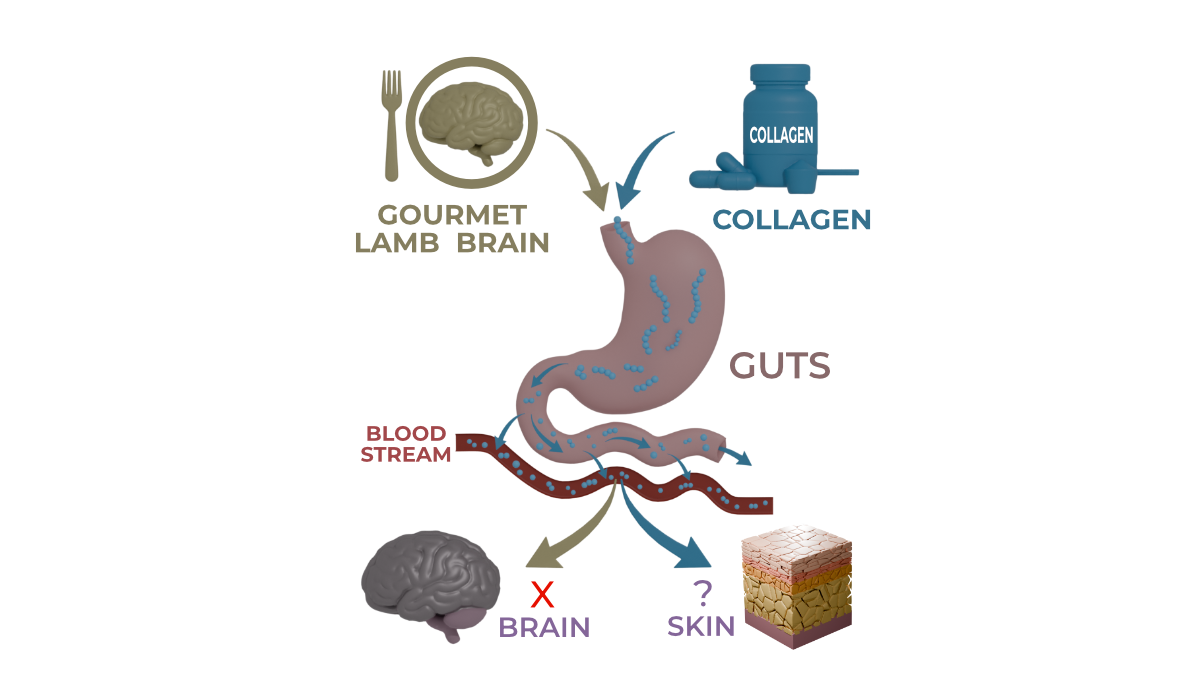
Figure 1. The “like-for-like” reasoning behind these foods: eat brain to boost your brain, eat collagen to boost your skin. But digestion breaks both foods down before their components enter circulation. Lamb brain is mostly fat, and there is no evidence that eating it selectively benefits brain tissue. Collagen supplementation has shown some effects in skin and musculoskeletal outcomes, but these cannot be explained simply by collagen being delivered to the tissue.

Dr. Jorge Romero
Published: Aug 31, 2026
Collagen supplements are a billion-dollar bet on a simple idea: that eating a protein delivers it, intact, to the tissue named on the label. It’s the same logic behind an old culinary tradition — eating animal brain to sharpen your own, a dish still served across Spain, Italy, France, Romania, the Middle East, and beyond. Nobody today believes fried brain boosts memory. So why do so many of us believe swallowed collagen becomes skin?
I ask partly as a scientist, and partly as someone who fell for it. A few years ago, dealing with knee pain, I bought collagen powder and mixed it into my coffee every morning — fully aware of the marketing at work on me, and doing it anyway. Almost two decades studying nutrition at a molecular level should have made me immune to a “like helps like” pitch. Instead, it just meant I understood exactly why the logic was wrong — after I’d already bought the powder.
So, is there anything to it?
The short answer: not in the way you’d think.
Digestion breaks collagen down into amino acids and small peptides—some of which can enter the bloodstream—but there’s no mechanism that simply routes the collagen you swallow straight to your skin. But the clinical picture isn’t a flat no either: some trials report modest improvements in skin hydration and elasticity, while others find little or no effect. And importantly, the apparent benefits often become less convincing in higher-quality or non-industry-funded studies. The honest story sits somewhere between marketing and dismissal—and it points to where the actual evidence is stronger.
The question isn’t settled. And that uncertainty is precisely what the marketing tends to hide.
Read time: 12 min
A Logic That Fooled Me — Even After Almost Two Decades of Studying Nutrition
Lamb brains have been eaten for centuries as a delicacy — sesos a la romana, fried in olive oil, in Spain; Italy’s cervello alla milanese and France’s cervelle d’agneau meunière, both cooked in butter; Romania’s creier pane, breaded and fried; and versions across Portugal, the UK, North Africa, and the Middle East. Even the Southern United States had its own take, brains and eggs, and lamb brain still shows up in Australia’s food supply today.
I’ll admit something here: I’ve eaten sesos a la romana more than once, and they’re genuinely tasty — soft, mild, a little custardy under the crunch. But I’ve never been able to get through a plate without a small part of my brain (no pun intended) quietly reminding me exactly what I’m eating.
Which is, in a way, the whole point of this article. Nobody today seriously believes a plate of fried brain sharpens your memory. Written out like that, it sounds almost silly — a relic of pre-scientific medicine, alongside eating liver to cure liver disease (even if the iron does boost your blood) or fish eyes for accurate sight.
Yet that was the exact, seductive logic that fooled me a few years ago. Dealing with sudden knee pain, I found myself buying collagen powder and mixing it into my coffee every morning—fully aware of the marketing doing its work on me and doing it anyway. It felt intuitive enough to override almost two decades spent studying nutrition at a molecular level, including a degree in nutrition, a master’s in food chemistry, a PhD in molecular biology tracking cancer networks, and years more at the NIH studying aging. Collagen is what cartilage and skin are made of, so surely putting more of it in would help build more of it back, right? If anything, my training should have made me completely immune to a primitive ‘like helps like’ pitch. Instead, it just meant I understood exactly why the logic was wrong — after I’d already bought the powder.
A few years ago, dealing with knee pain,
I found myself
buying collagen powder
It’s the same idea as the lamb brain. It just doesn’t sound silly this time, because it’s wrapped in a supplement label instead of a regional dish.
Why the Logic Doesn’t Survive Digestion — Literally
Here’s the part nutrition marketing tends to skip: your gut doesn’t know or care where a protein came from. Whether you eat lamb brain, beef collagen, or a boiled egg, digestion breaks proteins down into amino acids and small peptide fragments. Some collagen-derived peptides can survive digestion and enter the circulation, but the collagen you swallow does not travel intact to your skin. Your body absorbs those building blocks and uses them according to its needs—not according to the packaging they arrived in.
And those signals are constantly changing—they reflect what your body needs right now. The same amino acids might be used to build muscle or skin, burned for energy when food is scarce, recruited by the immune system when you’re fighting an infection, or prioritized by your liver to clear acetaldehyde after a rough wine hangover. Even if peptide fragments can trigger signals for new protein synthesis in your skin, your body still has to balance those signals against the demands of homeostasis. It doesn’t take requests from the supplement label.
And as we age, changes in digestion, nutrient handling, metabolism, and the presence of chronic conditions can further complicate how nutrients are processed and used by the body.
There is no conveyor belt from “collagen you swallowed” to “collagen in your face.” The idea that ingested collagen travels intact to your dermis and gets woven directly into your skin isn’t how digestion works — for the same reason lamb brain never made anyone smarter.
There is no conveyor belt
from “collagen you swallowed”
to “collagen in your face.”
So Does Oral Collagen Do Anything?
This is where it gets more interesting than a simple “it’s a scam” — because that’s not quite true either.
The clinical evidence is genuinely mixed, and it splits in a very telling way. Large systematic reviews of randomized trials often report no significant benefit for skin aging. But other reviews, pooling similar trials, do find modest improvements in hydration and elasticity. One of the largest review to date looks at the evidence so far — a 2026 review pulling together 113 trials and nearly 8,000 people, with no supplement-industry funding behind it — landed in that same modest-but-real place: real improvements in elasticity and hydration with consistent use, but nothing convincing for wrinkles specifically.
One especially telling analysis makes the funding pattern concrete: pooling 23 trials together, collagen looked clearly effective. But split those same trials by who paid for them, and the ones without industry funding found no significant effect at all — while the industry-funded ones did. That doesn’t mean the industry trials are wrong — but it’s a real enough pattern that “clinically proven” on a label is worth a second look.
There’s also a quieter problem underneath all of this: trials that simply never surface. A study auditing ClinicalTrials.gov found that among thousands of completed, randomized trials with results posted, half didn’t even report a treatment effect or a p-value in their own registry entry. So when a brand cites “clinically proven,” it’s worth asking not just who funded the trial, but how many similar trials for the same product were run and never mentioned again.
If collagen supplementation does anything real, the honest mechanistic story isn’t “it becomes your skin.” It’s something more modest: extra amino acids may nudge your own fibroblasts to synthesize slightly more collagen, or small peptide fragments may act as signals that mildly stimulate your skin’s own repair machinery. That’s a plausible, minor effect — not a rebuilding of your face from the inside.
Scientific literature suggests further research
The Part Supplement Labels Never Mention
Here’s the deeper problem: aging isn’t simply a shortage of collagen.
Collagen isn’t unique to skin, either — it’s the structural scaffold of cartilage, tendon, bone, and other connective tissues too, where the same fragmentation-and-stiffening pattern shows up with age (a story for another article).
In skin specifically, the collagen that’s already there doesn’t disappear — its production and turnover change, fibers become fragmented and disorganized, and the extracellular matrix becomes stiffer and less functional. Skin also loses hydration for a separate reason: hyaluronic acid, part of the matrix that holds water in the tissue, declines with age too.
So what’s happening in aging skin is more complicated than “not enough collagen”. It’s a problem of structure, turnover and regulation — not a shortage of raw building material.
Put simply: Adding more protein to the diet doesn’t directly reverse any of those processes—which may help explain why the clinical evidence for collagen supplementation is far less straightforward than the marketing suggests.
Skin doesn’t lose its youthful look
simply because it runs
short of raw collagen protein
What About the Blend in Your Jar?
Walk down the supplement aisle and you’ll rarely find collagen sold alone anymore. It comes bundled with hyaluronic acid, vitamin C, and a handful of other ingredients — the implicit promise being that the combination works better than any single piece of it.
So does the combination actually outperform collagen alone? One trial tested exactly that. Researchers gave 87 women either a placebo, collagen plus vitamin C, or that same combination with hyaluronic acid added, for sixteen weeks. Both active groups showed real improvements — greater dermal density, better skin texture, fewer visible wrinkles. But neither group improved on skin elasticity or hydration, which happen to be precisely the outcomes hyaluronic acid is supposed to move. In the one study built to isolate its contribution, adding HA to the mix didn’t produce a detectable extra benefit on the parameters it’s marketed for.
Does the combination actually
outperform collagen alone?
That doesn’t mean these ingredients never work together — in laboratory studies, some pairings do show genuine synergy. But a synergy shown in a petri dish is a different claim from a synergy shown in a person’s face after sixteen weeks, and so far the direct human test of “collagen plus HA” hasn’t confirmed the second ingredient is pulling its weight.
What the Evidence Actually Supports
None of this means there’s nothing you can do — it means the leverage is somewhere else. The interventions with the most consistent evidence behind them are less exciting to sell in a jar: daily sun protection, which prevents a large share of visible skin aging in the first place; topical retinoids, with decades of solid trial data for stimulating genuine collagen remodeling in the skin itself; and, interestingly, oral hyaluronic acid, which has recent, reasonably well-designed trials showing measurable improvements in hydration and elasticity — a more mechanistically coherent story than collagen, since it targets the water-retention deficit directly.
None of that fits as neatly on a label as “contains collagen.” But it’s the difference between hoping your body performs a kind of biological magic trick, and giving it something that addresses what’s actually changing as skin ages.
The lamb brain never made anyone smarter. That was never really in question. The only reason the collagen version of the same idea gets a pass is that it’s dressed up in a lab coat instead of a frying pan.
Bibliography
- Ravindran R, Pizzol D, López-Gil JF, et al. Collagen Supplementation for Skin and Musculoskeletal Health: An Umbrella Review of Meta-Analyses on Elasticity, Hydration, and Structural Outcomes. Aesthetic Surg J Open Forum. 2026;8:ojag018. Bassila C,
- Bassila JC, Slim M. Efficacy and safety of hydrolyzed collagen supplementation on skin health outcomes: a systematic literature review of randomized controlled trials. Eur J Clin Nutr. 2026.
- Bochniak, O.; Piotrowska, K. Collagen Supplements in Skin Aging and Treatment—A Narrative Review. Appl. Sci. 2026, 16, 3880. https://doi.org/10.3390/app16083880
- Myung SK, Park Y. Effects of Collagen Supplements on Skin Aging: A Systematic Review and Meta-Analysis of Randomized Controlled Trials. Am J Med. 2025 Sep;138(9):1264-1277. doi: 10.1016/j.amjmed.2025.04.034. Epub 2025 May 3. PMID: 40324552.
- Dakhovnik A, Mantovani M, Knufinke M, Brügger V, Pramono I, Statzer C, Saravi B, Demidenko O, Budovskaya Y, Rümmelein CB, Chabloz S, Ewald CY. A collagen amino acid composition supplementation reduces biological age in humans and increases health and lifespan in vivo. NPJ Aging. 2025 Nov 20;11(1):91. doi: 10.1038/s41514-025-00280-7. PMID: 41266379; PMCID: PMC12635253.
- Virgilio N, Schön C, Mödinger Y, van der Steen B, Vleminckx S, van Holthoon FL, Kleinnijenhuis AJ, Silva CIF and Prawitt J (2024) Absorption of bioactive peptides following collagen hydrolysate intake: a randomized, double-blind crossover study in healthy individuals. Front. Nutr. 11:1416643. doi: 10.3389/fnut.2024.1416643
- Montero-Vilchez T, Gálvez-Martín P, Sanabria-de la Torre R, Cuenca-Barrales C, Molina-Leyva A, Martinez-Puig D, Velasco-Alvarez J, Arias-Santiago S. Oral Supplementation with a New Hyaluronic Acid Matrix Ingredient Improves Skin Brightness, Hydration, Smoothness, and Roughness: Results from a Randomized, Double-Blinded, Placebo-Controlled Study. Dermatol Ther (Heidelb). 2025 Aug;15(8):2099-2116. doi: 10.1007/s13555-025-01447-6. Epub 2025 Jun 11. PMID: 40498387; PMCID: PMC12256382.
- Amin P, Sarabi A, Choe S, Scott S, Suh S, Mesinkovska NA. Oral Hyaluronic Acid Supplement: Efficacy in Skin Hydration, Elasticity, and Wrinkle Depth Reduction. J Drugs Dermatol. 2025;24(9):910–919.
- Dolečková I, Kušnierik P, Berka V, et al. Oral sodium hyaluronate improves skin hydration, barrier function and signs of aging: a randomized, double-blind, placebo-controlled trial in 150 healthy adults. Sci Rep. 2025.
- Dechartres A, Bond EG, Scheer J, Riveros C, Atal I, Ravaud P. Reporting of statistically significant results at ClinicalTrials.gov for completed superiority randomized controlled trials. BMC Med. 2016 Nov 30;14(1):192. doi: 10.1186/s12916-016-0740-1. PMID: 27899150; PMCID: PMC5129217.
- A 56-Day Exploratory Study of NatureU® Mind Care BeautyU Caps on Skin Aging Parameters (NUAA) https://clinicaltrials.gov/study/NCT07571629
- Žmitek K, Žmitek J, Hristov H, Rogl Butina M, Keršmanc P, Pogačnik T. The Effects of Dietary Supplementation with Collagen and Vitamin C and Their Combination with Hyaluronic Acid on Skin Density, Texture and Other Parameters. Nutrients. 2024;16(12):1908.
- Jiang Y, et al. Synergy of GHK-Cu and hyaluronic acid on collagen IV upregulation via fibroblast and ex-vivo skin tests. J Cosmet Dermatol. 2023;22:2598–2604.
- Brueckheimer PJ, Costa Silva T, Rodrigues L, Zague V, Isaia Filho C. The Effects of Type I Collagen Hydrolysate Supplementation on Bones, Muscles, and Joints: A Systematic Review. Orthop Rev (Pavia). 2025 Feb 19;17:129086. doi: 10.52965/001c.129086. PMID: 39980497; PMCID: PMC11842160.
Everything discussed here comes from a mix of mechanistic biology and clinical trial data — some of it industry-funded, some independent, and none of it settled. This isn’t a verdict against collagen supplements; it’s a reminder to ask what’s actually being measured, and by whom, before “clinically proven” does the persuading for you.